
Gillespie Projected vs Actual Release
TDCJ calls its current-inmate field “Projected Release Date.” It is a status calculation for a person presently incarcerated in a TDCJ facility, not a certificate that release occurred. The actual release or discharge date belongs in the historical corrections record. At the county level, an admission/release entry supplies the operational exit time, while a judgment and jail calculation explain the sentence basis.
A pretrial Gillespie County Jail detainee generally has no sentence-based projected date. Bond, a dismissal or other court order, transfer, and outside holds can determine what happens next. Even after bond is posted, processing and other holds may prevent immediate departure.
Find a Gillespie Projected Release Date
- Determine whether the person is in Gillespie County Jail or a Texas Department of Criminal Justice facility. Do not use the state calculation for a local jail sentence.
- For TDCJ custody, open the official inmate search. Search by TDCJ number or SID for the strongest match, or use last name plus at least a first initial.
- Confirm identity through the displayed name, age or identifiers, offense county, and related facts before reading the date.
- Record the exact “Projected Release Date,” the Parole Review Information, and the date of the lookup. TDCJ updates on working days and warns that data are at least 24 hours old.
- For a county sentence, obtain the judgment, jail-credit information, and the Sheriff's calculation. Call Gillespie County Jail or request the existing release record rather than applying a state formula.
- If the projection passes or the TDCJ result disappears, request actual release/discharge history from TDCJ or the county custodian.
The official current-search capture shows both the input route and its scope warnings:
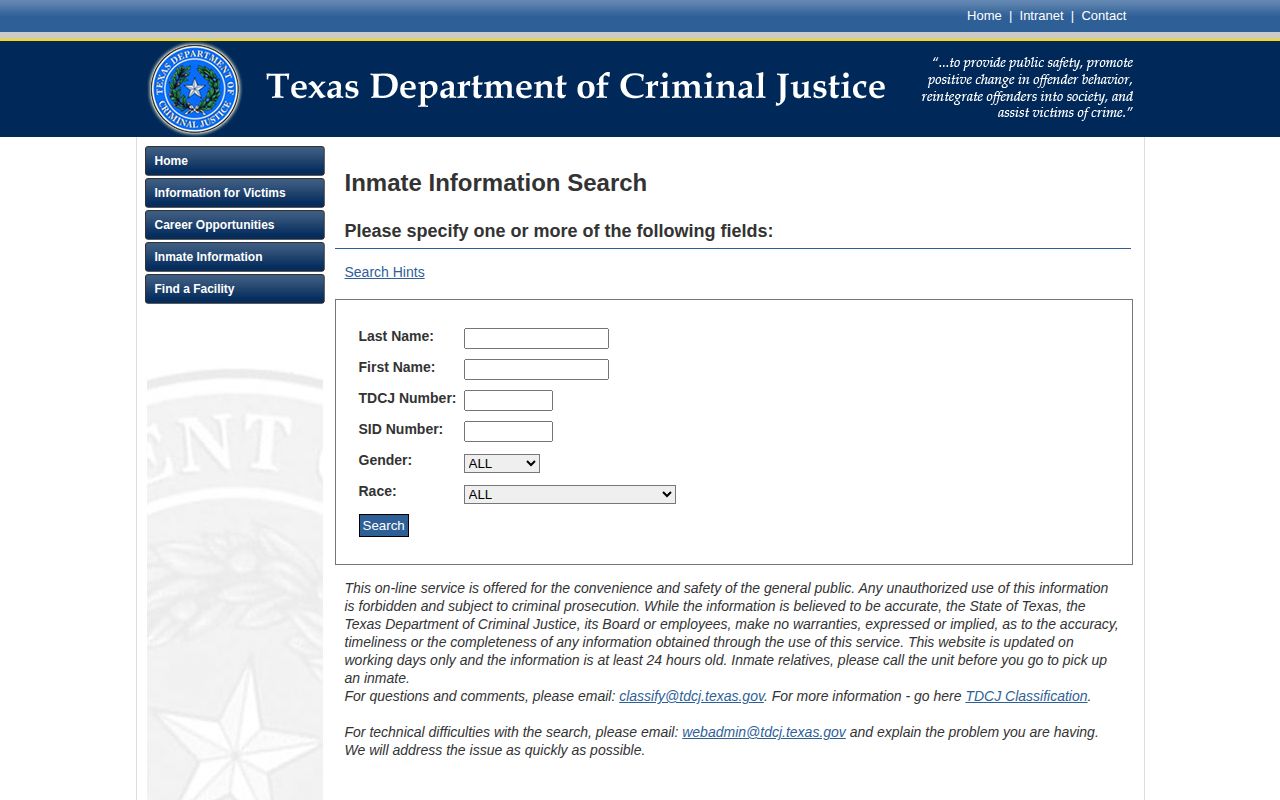
Those warnings prevent a current-only result from being mistaken for a statewide archive of released Texans.
Texas Good Time and Gillespie Dates
Texas Government Code §498.003 governs good-conduct classifications and credits in part. The statute describes good time as a privilege rather than a right and says it does not reduce the sentence itself. It can affect eligibility calculations when the applicable release law allows, but it should never be used as a simple subtraction from the judicial sentence.
Classification, disciplinary forfeiture, additional sentences, jail credit, concurrent or consecutive terms, parole review, and mandatory-supervision decisions all can change the practical calculation. Texas law also varies by offense date and offense type. Therefore a generic calculator cannot reproduce the official TDCJ record reliably.
County jail calculations are separate. The Gillespie sentencing order, credited time, relationship among sentences, and Sheriff's official calculation govern local custody. Research found no published Gillespie weekend-release or county good-time policy, so no local shortcut or release-day rule should be inferred.
Why Gillespie Release Dates Move
| Factor | Possible effect |
|---|---|
| Good-conduct classification or forfeiture | Changes credits used in eligible calculations without shortening the sentence itself. |
| Jail credit or recalculation | Corrected credited time can alter a county or state computation. |
| Additional or corrected judgment | A new sentence, amended order, or concurrent/consecutive ruling changes the basis. |
| Parole action | A favorable vote may create a conditional path, but required programs and processing can remain. |
| Mandatory supervision | Eligibility and Board decisions vary by offense date and statutory category. |
| Detainer or receiving agency | Departure from one custodian may become transfer rather than community release. |
| Data timing | TDCJ's at-least-24-hour lag can make a live change appear later online. |
These factors explain why a displayed projection is useful but provisional. They also show why a jail-bond posting or Board vote should not be published as the actual exit time.
Confirm a Gillespie Release Date
For a Gillespie County Jail case, request the booking sheet and custody admission/release date and time from the Sheriff. Ask for the disposition or release code and receiving agency if releasable. The county Courts & Justice portal includes criminal, jail, and jail-bond categories, which can explain court and bond events, but a posted bond does not establish the moment of physical release.
For state history, TDCJ's free offender-information route requests the name and seven-digit TDCJ number. If the number is unknown, provide an exact birth date or approximate age plus county of conviction. Ask for the actual release/discharge date, incarceration history, and status meaning. A more specific record can be requested at PIA@tdcj.texas.gov.
The Gillespie VINELink release check can provide a custody-change alert, and TDCJ IVSS can cover state release-to-supervision or discharge events. Preserve the alert, but confirm the date and legal release type through the responsible custodian's record.
Texas Has No Blanket 85-Percent Rule
Texas should not be described as requiring every incarcerated person to serve 85 percent of a sentence. For the serious-offense and deadly-weapon group addressed in Government Code §508.145(d), parole eligibility generally occurs when actual calendar time, without good-conduct credit, equals one-half of the sentence or 30 years, whichever is less, subject to the statutory minimum. Capital and other categories have their own provisions.
Mandatory-supervision exclusions are separately listed in §508.149. Older references to “3g” offenses should be translated to the present Code of Criminal Procedure article 42A.054 framework. This state-specific structure is why an online slogan or percentage calculator can misstate a Gillespie-related TDCJ date.
The distinction also reinforces §498.003: good time may affect an eligible calculation, but it does not erase part of the judicial sentence. The exact offense, offense date, sentence, credits, and Board process must be read together.
Mandatory Supervision Changes Date Meaning
TDCJ explains “Projected Release Date” differently for some mandatory-supervision cases based on offense date. For certain eligible offenses before September 1, 1996, release occurs on the projected date if parole has not already occurred. For offenses on or after that date, eligible mandatory supervision is discretionary with the Board.
If the Board denies mandatory supervision, or the person is ineligible, TDCJ may describe the projected date as the discharge date. Even then, the online value remains subject to sentence recalculation and does not promise an hour, exit door, transportation plan, or destination. A favorable parole result also is not physical-release proof. TDCJ lists 844-512-0461 for pre-vote status and 512-406-5202 for release status after a favorable vote.
Gillespie Jail Dates Use Local Records
The TDCJ projected field does not calculate a sentence served at Gillespie County Jail. For local custody, locate the sentencing judgment through the county criminal record, identify credited jail time and whether terms run together or one after another, then obtain the jail's existing calculation. If the person was not yet sentenced, treat any proposed date as uncertain because court action, bond, and holds remain controlling.
The jail can be reached at 830-997-7585, and the Sheriff's public address is 1601 East Main Street, Fredericksburg, TX 78624. No official release-processing hour, weekend schedule, waiting procedure, or property-return timing was located. Calling for current operational information is more accurate than inventing a release-day practice. If a record says “released to TDCJ,” “released to detainer,” or names another receiving agency, continue the search with that custodian.
Read Gillespie Parole Information Separately
The projected date and parole review information answer related but different questions. TDCJ Parole Division identifies cases ahead of initial eligibility and later review, then a three-member Board panel reviews the file. Two matching votes decide. Texas does not conduct a formal person-by-person parole hearing, so there is no Gillespie hearing calendar that supplies a release date.
An FI approval code can carry a date or program condition. It does not mean the person has left the institution. Plan approval, required programming, conditions, and physical-release processing may remain. Denial codes can set another review or require service under the applicable decision. Use the official vote-options explanation rather than guessing from the letters, and then confirm the later release event through the status line or state history.
Parole eligibility itself is not the same as the projected release field. Eligibility marks when consideration may occur under the governing offense, date, and sentence provisions. The projection reflects the correctional calculation and statutory path then recorded by TDCJ. Recording both fields, along with the lookup date, prevents one from being reported as the other.
After a Gillespie Projection Disappears
A person who no longer appears in TDCJ's web search may have been released, transferred, or affected by a system update. Since the search covers only current TDCJ prisoners, the absence cannot establish the actual date or final discharge. Use TDCJ's offender-information email page for the free information route. Provide name and TDCJ number, or substitute the requested birth-date, age, and conviction-county details when the number is unknown.
Ask a narrow historical question: the actual release date, actual discharge date if different, incarceration history, and the meaning of the recorded status. TDCJ telephone information is available on weekdays from 8 a.m. to 5 p.m. at 936-295-6371 or 800-535-0283. For a formal or more specific existing record, use the Public Information Act route. This closes the gap between a changing online estimate and the durable release history.
Public Record Search
Sponsored Results